
In the summer of 2023, I got my Swiss motorboat license in Zurich. I trained for it also in Zurich. I have also written a blog post in the past, about how to get a Swiss motorboat license. While on the surface it might seem like driving a boat is the same as a car. However in reality it is not. Boat behaves very differently to steerage and motor. This is especially apparent when navigating in close quarters, like a marina or a habour. In Switzerland, the requirement for a motorboat license is rather strict compared to other European countries. It is expected to learn about 16 maneuvers and in the exam they might ask you to demonstrate about 8 maneuvers on the exam day.
I took about 20 lessons, in this post I will summarize what I learnt in those lessons. This post will also serve as a reference to the maneuvers. With knowledge of all these maneuver, I was able to pass the motorboat driving exam of the canton of Zurich. Additionally after getting my license, I also managed to rent a motorboat in Switzerland on a few occasion and feel confident, driving the boat.
- Driving on the lake
- Bow Landing on the Pier.
- Forward Landings on a Pier
- Departure from a Pier
- Turning on Place
- 90 Degree Landings
- Landing in a Box Mooring
- Backward Port/Starboard Landings
- Mooring the Boat
- Anchoring
- Man Overboard
- Positioning and Navigating with a Compass and Nautical Charts
- Determining Current Position
- Determining a Direction to the Destination
Driving on the lake
I think driving on lake is the easy part. Driving fast in an open area is almost like driving a car. You give the gas and it goes fast, you reduce the gas and it slows down. You turn the steering and the boat turns accordingly. It can be quite challenging to drive when it is windy and when there are a lot of waves. In such settings, it can be hard to keep a straight path and you need to constantly adjust the steering and take a bearing to a landmark on the ground. If no landmark is visible one needs to follow a compass direction.
There were a few new things I experienced on it. One of them was the use of engine blowers (only applicable for inboard engines). The engine compartment might have vapors of fuel. when it is hot outside the vapors might spontaneously ignite when starting the engine. The captain should start the blowers, when they turn off the engine and when they are about to start it. It is recommended to keep the blower on for about a minute before starting the engine and after turning the engine off. This lets all the fuel vapor out. With the presence of vapors of fuel in the engine compartment, you might have a fire in the engine which is a catastrophe. This is usually only for inboard engine (like the Z-drive) but for an outboard engine this is not applicable as there is no engine compartment.
Another thing that I learnt was when you are fast and want to slow down, you need to do that in steps. If you abruptly reduce the gas, the water might enter the cockpit. Additionally, when approaching shores one needs to come perpendicularly to the shore and reduce the speed to 10km/h when about 300m from the shore. There could be more area specific rules. You need to know how to look them up. Usually, one will need to consult a navigation chart service like navionics for this. Also when increasing speed, it is important to inform all the people that we are increasing the speed. This allows them to be prepared for the jerk.
Bow Landing on the Pier.
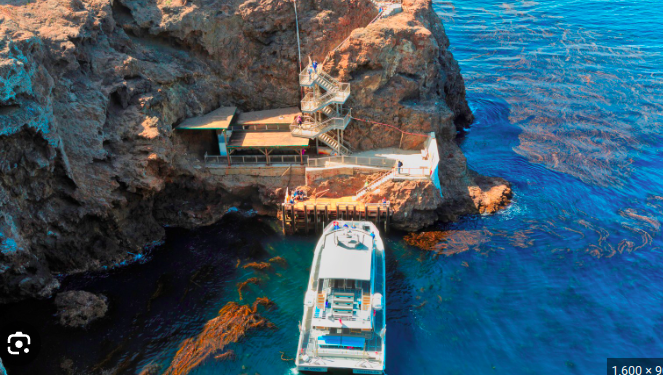
This landing is relatively easy to do. The end result looks something like the above picture. You only need good control with the braking of the boat. The boat needs to be about 10-20cm from the pier. Remember that a boat does not have a brake like a car. You need to stop a boat with the backward gear. Also remember to check there is enough water depth (draft) in the place that you are trying to do the docking.
Here is a video illustration of it. Courtesy Luna Sailing, Zurich.
Forward Landings on a Pier
Harbors commonly have piers which lets the passengers embark and disembark a boat. A Captain needs to know how to land and depart correctly and in a safe manner. This part is not very intuitive. If you do it without prior guidance, ie. like a car you are almost guaranteed to fail and most likely cause damage to your boat.
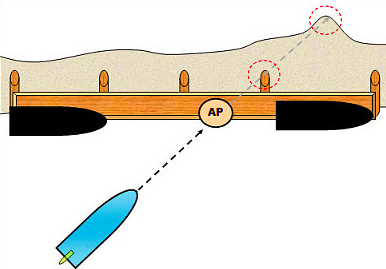
In nautical terms, the left side of the boat is called the port side (German: Backbord), and the right side is called the starboard side (German: Steuerbord). So, there are two variants of this landing: a) The starboard forward landing (German: Steuerbord Vorwärtslandung) and b) port forward landing (Backbordseitelandung). Here is the process to perform it:
- Approach the point you want to dock (AP) at a 45 degree angle.
- When about a boat length away (~4-6 meters). Turn the steering wheel completely away from the pier. For port landing, it will be turn the steering wheel to the right.
- Give forward gear for about 3 seconds. After 3 seconds gas in 0-position. (the steering is turned away from the pier when you are giving the gas).
- Steering wheel in the middle.
- Brake. Note that boat does not have a brake. You need to use the backward gear to stop the movement.
- The drift automatically takes the boat to the pier.
Here is a video illustration of it, courtesy of Luna Sailing, Zurich.
Sometimes, after this maneuver, you might not be parallel to the pier. It is also possible that you are about 1 meter or so away from the pier and at an angle. One needs to make the correction in this case. The correction is always done by steering away from the pier, no matter how the boat is positioned (which is very counter intuitive). If the bow (front of the boat) is away from the pier compared to the stern (back of the boat), one needs to use the backward gear (with steering away from the pier). If the bow is away from the pier (than the stern), then you need forward gear. It is important to do this correctly, or else your boat’s propellers will hit the pier and damage them.
This landing is the most frequently needed harbour maneuver. In the few times I rented a boat, I had to perform this every single time.
Departure from a Pier
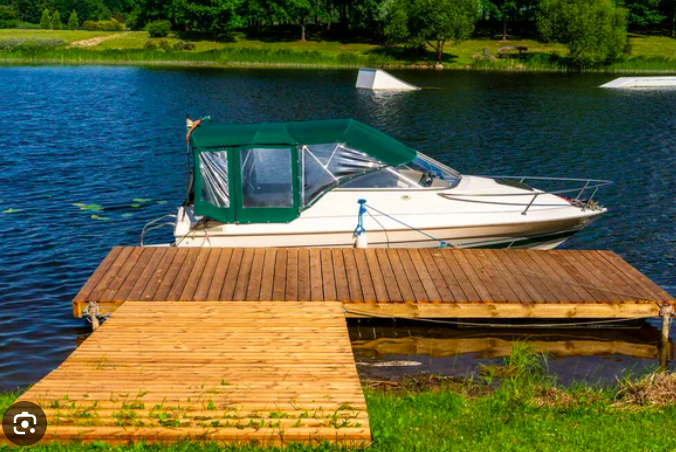
Here the situation is that your boat is lying on the pier on its port (or starboard side), as depicted in the picture above. We wish to depart from the pier. This maneuver is rather quite counter intuitive as well. At this moment if one follows intuition and tries to drive like a car by turning the steering wheel away from the pier and forward gear, you are sure to damage your propellers. Take a moment to re-read the previous sentence. Here is the correct way:
- Steering wheel towards the pier
- Gear forward for a short time ~1 sec.
- Steering away from the pier.
- Backward gear for 5 sec (until the stern has made sufficient distance from the pier)
- Steering wheel in the middle and forward gear until stopped. At this point we have made a S-line movement.
- After this, we can use our intuition of steering wheel away from the pier and forward gear.
Turning on Place
This is yet another important maneuver. The situation is that, you are in the channel which is quite narrow. Like the one below in the harbor of Tieffenbrunnen. Our boat is in a position like the arrow. The bow (front of the boat) pointing to a wall. We wish to turn around and go back. I think this is a very common situation when you are searching for parking places and you enter a channel only to realize the non availability of parking place (mooring). This is where the turning in place maneuver helps.
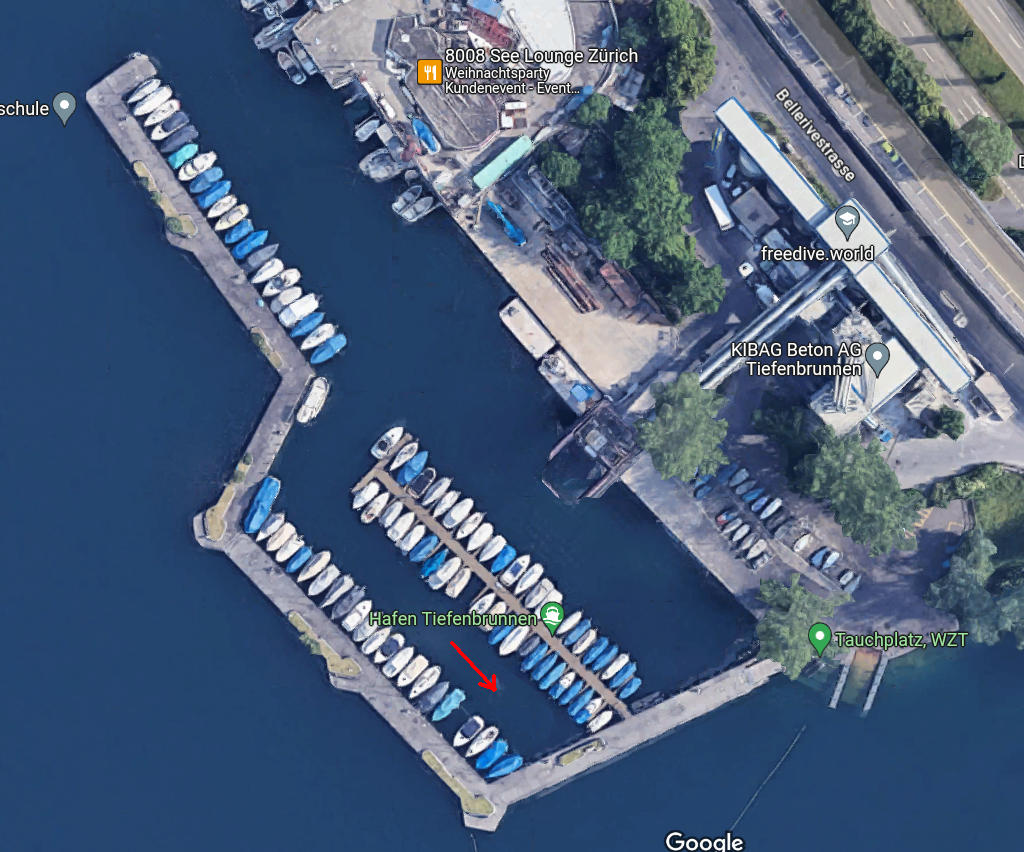
There are two ways to turn in such a situation. Clockwise (on the left) and Anticlockwise (on the right). Here is how to do it (assuming you want to start turning from the left):
- Steering to the left
- Short gear front (~1-2sec)
- Steering wheel to the extreme right.
- Short gear back (~1-2sec)
- Repeat the above steps as many times as needed until the boat has turned around.
Under certain situation, one can also start the maneuver with steering wheel right back and then steering wheel front and forward gear. Here is a video demo of it.
90 Degree Landings
This landings are in some way similar to the 45 degree landings. In this landing, our bow (front of the boat) is at 90 degrees to the pier. We want to do either a port of starboard landing from this situation. Such a scenario may arise when we are in a narrow channel and the pier is at the end of the channel 90 degrees to the channel. If the width of the channel is wide enough, we can also do a 45 degree landing. However if the space is really narrow, we are forced to do the 90 degree landings. The steps to do it, when the bow of the boat is about 6-8m away from the pier.
- Drive very slowly at 90 degree to the pier.
- Steering wheel away from the pier.
- Forward gear for 3 sec.
- Forward gear for 3 more sec, or until the boat is parallel to the pier.
- Steering wheel in the middle
- Brake. Backward gear.
- Use correction maneuer if necessary. These will be exactly the ones in 45degree landings.
Landing in a Box Mooring
Often times in marinas you will be mooring (parking) your boat to go on land for an extended period. In such cases often times you will have your own mooring place. It usually somewhat resembles a car parking box. At the entrance of each place is a pole sticking out from the water. You are suppose to put your boat inside the box and then tie it with ropes to the poles. I think it is a good idea to be confident with this maneuver. You need to be able to get your boat out of the mooring. After you are back, you need to be able to put the boat inside the mooring safely without hitting other boats. Often times you are at 90 degrees to the mooring boxes as you approach yours. Below is a picture of how a mooring box looks like:
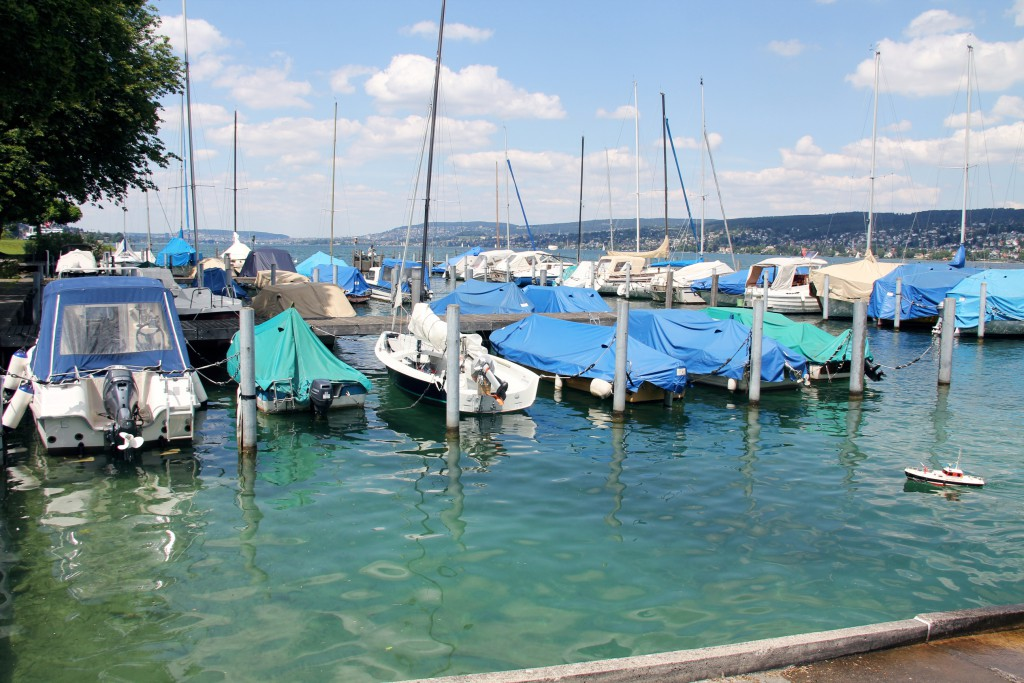
There are two variants of the mooring in the box. The forward and the backward landing in the box. I personally always do the forward landing as it is a tiny bit easier than the backward one. Although I can do the backward landing I feel less confident about it. In both the cases, width is a determining factor. One needs to be aware of where the wind is blowing from and then adjust accordingly. Steps for forward landing:
- Keep lateral distance from the mooring poles. At least 6-8m.
- Drive forward until your shoulder is in the middle of the 2 poles.
- Steering wheel away from box and backward gear. Until your shoulder is at the back pole
- Steering wheel to the pier and forward gear. This is the same process as turning in place.
- Then when you are aligned straight between the 2 poles, drive straight it.
The logic behind this maneuver is that you are positioning the boat in between the two poles and then do a turn-in-place.
You have to be very mindful of the winds for this step. It is usually a problem when the wind is at your port or starboard side when starting the maneuver. Moreover, remember to put the fenders on all the sides of your boat when attempting this.
Very often, you might not be parallel between the two poles but at an angle. This happens if your angle is little bit off and you hit the pole slight. For forward landing you have to always use a backward gear for correction and remember the rule: ‘steering to the bow‘. This means if the bow (front of the boat) is pointing to the right, then, you need to turn the steering to the right and use backward gear. If you get this wrong you will surely hit the boat next to you of the poles and damage your boat.
Backward landing in a box
This is almost the same as the forward landings. At the end the expected state is that your stern (back of the boat) is at the pier and your boat is between the mooring poles. You always have to start with a backward gear no matter if it is forward or backward landings in a box. For the correcturs for backward landings, one has to use the forward gear. Also remember the rule ‘steering away from the bow’.
Backward Port/Starboard Landings
In this landing you do a starboard or port landing but the pier is behind you. I find this maneuver to be not superuseful in practice. I feel, I can simply drive backward and then do a forward landing. It will achieve the same effect. I am yet to see a scenario where knowing this maneuver would have made my life easier. Nevertheless, in the Swiss category A practical test they ask you to do this maneuver.
Mooring the Boat
This is about how to tie to boat when you have landed your boat. If you have to get off on the land, you will always have to tie your boat. When you are moored inside a box, there are usually lines on the poles where you tie to and then get off the boat from the front and tie more lines to the boat cleats to the ones on the pier. One would usually use the cleat-hitch to tie in this case.
In some places, you need to do a bow landing and then park. In such cases there is sometime a mooring ball. So you tie the stern (back of the boat) to the mooring ball in the water and then the bow (front of the boat) to the cleat/bollard on the pier. In all the cases, it is always a good idea to have fenders around your boat. If there are no mooring balls, you might also have to do a stern anchor and then do a bow landing. Then get off the boat and tie the bow to the pier.
More often that that, we have to park the boat in a public parking or to fill up our fuel tanks. In such cases you are starboard/port landed on the pier. During the practical test they ask to park at a simulated fuel station and ask you to tie the boat. So, for it we do the 45 deg landing and then:
- Turnoff the engine and start the engine exhaust pump. This is important for fire safety. Only needed for inboard engines.
- Get out of the boat with forward and backward lines in your hand. Even before you have landed you need to prepare two lines. One to the front cleat and one to the back cleat.
- The boat has to be in middle of two poles.
- Then tie the bow line to the pole followed by the stern line. One will usually use a clove-hitch knot to tie the rope (line) to the poles.
- Then take a third rope and tie it to the middle cleat on the boat and then to the pole. One can use either clove-hitch or bowline knots to tie it.
- Important is to leave some slack (about 0.5m) in the rope so that boat can move a little due to waves etc.
After the engine exhaust pump is running for a few minutes, one can turn it off and leave the boat there. You will often need to do this if you go to a restaurant which has boat parking. There are many such restaurants on lakes of Switzerland. And it feels quite cool to visit these with a boat. Here is a video of how it is to be done:
When unparking the boat as you are ready to leave, it is a good practice to first start the engine before you untie the knots. This is done so that the engine warms up a bit and wont switch off as you are ready to leave. The engine switching off happens often in winter. And untied boat with no power is a receipe for disaster. You really don’t want your boat wearing off.
Anchoring
Anchors are used to hold a boat on place. These metallic objects look like a hook. A rope is tied to the boat with a rope. They dig into the sea floor and hold the boat in place. That’s the theory. Now lets looks at some situations where we have to anchor a boat. And then the nuances of each situations.
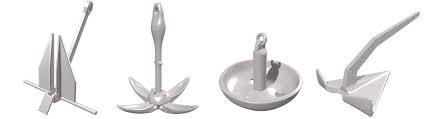
There are two places you can tie your anchor to your boat. a) Bow Anchor b) Stern Anchor. In bow anchoring the anchor is dropped at the bow (front of the boat). While in stern anchoring it is dropped at the stern (back) of the boat. The basic idea in that, we drop the anchor and then move the boat so that the anchor digs in the ground. For bow anchor we need to move the boat backward after dropping the anchor. For stern anchoring we need to move the boat forward after dropping the anchor.
When do we have to Anchor?
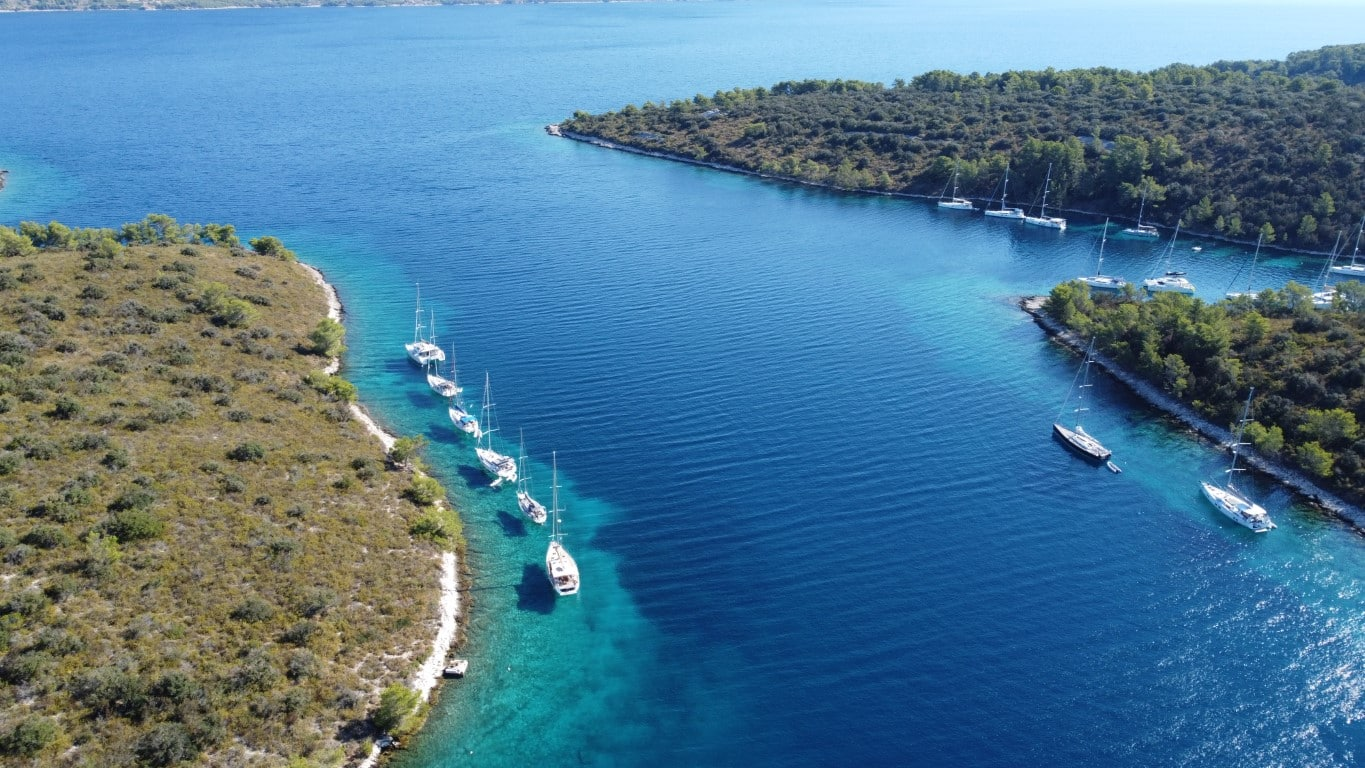
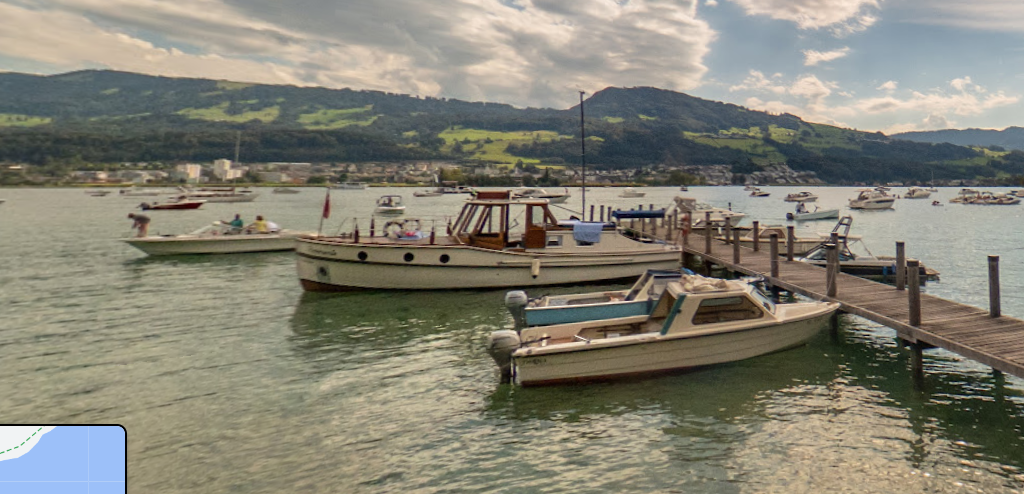
You will anchor in open waters (ie. not on a pier) like in the image below. Or you will have to sometimes use your anchor to moor on a pier. You might want to do anchor maneuver, so that you can rest, eat food etc., while the boat stays on one place. It might be interesting to know that in one waters, anchored boats always point to the direction of the prevalent wind.
For anchoring, we will need about 3-5 times rope length for depth of water. For example, if the depth at a spot that you wish to anchor is 5m deep, then you need rope of 15-25m in length. On open waters you will always do a bow anchor. To do that, prepare the rope so that there are no knots in the rope. One end of the rope has to be tied to the boat and the other to the anchor. Then from the front part of the boat (ie. bow) we drop the anchor and slowly drive the boat backward until we have let out 5 times the length of the rope as the depth.
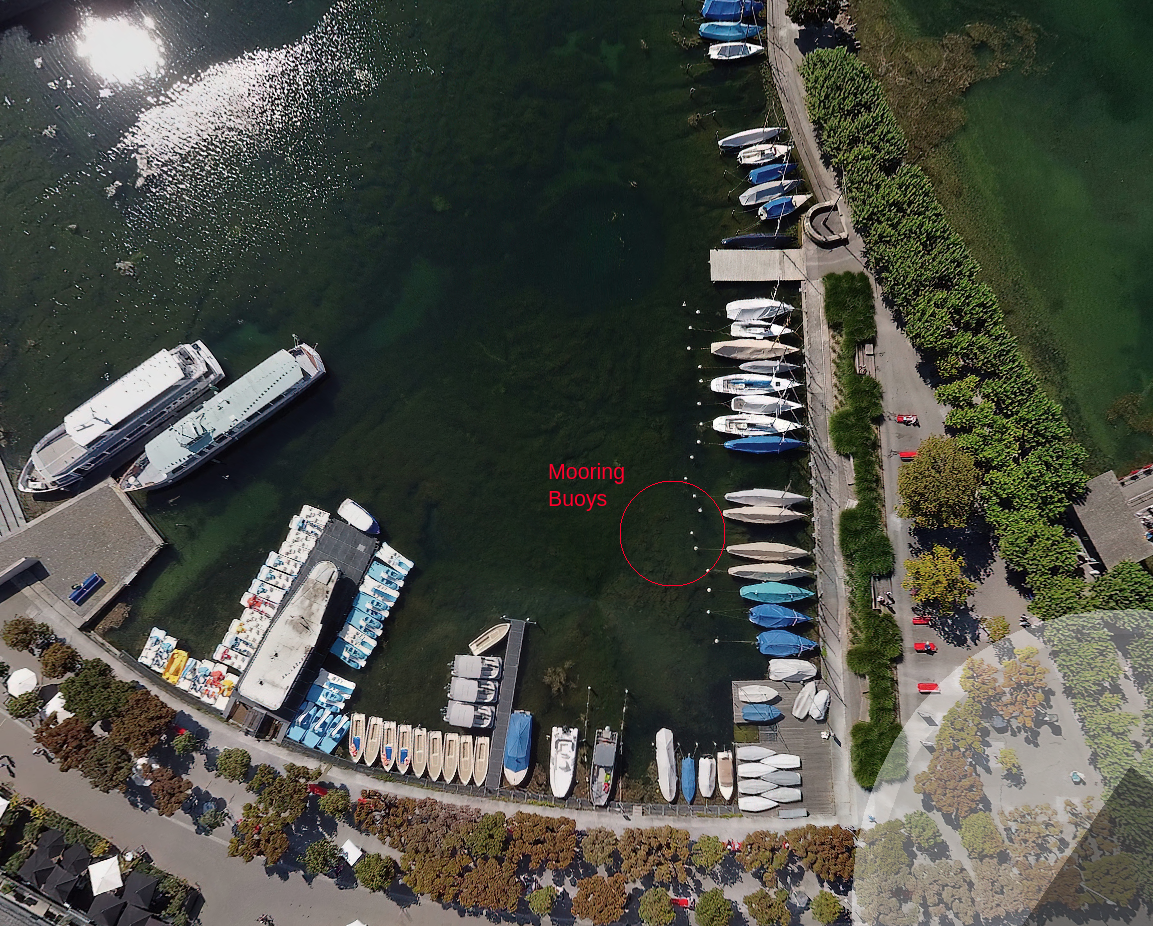
In busy town piers like the one below, you can do either a stern anchor or a bow anchor. However, it is recommended to do a stern anchor here. This is because you don’t want your propellers near the pier. You are more likely to damage your propellers when they are faced to the pier.
If you have to stern-anchor at a pier like this, you would drop the anchor when about 4-5 boats lengths from the pier. Then do a bow landing on the pier. After which with another rope, tie the bow of the boat to the pole on the pier. On lake of Zurich, you most often have to do stern anchor with your motor boat when you have to park your boat for a few hours on a pier. Such landings save space compared to doing port/starboard landings. Look at the video below, to know how-to stern anchor.
Another related term is Mediterranean-mooring. To save space, boats have to either do stern-anchor or bow-anchor to land of a pier. Almost all the sailboats have their anchor tied with chains to the bow of the boat (front). Thus they are forced to do the bow anchoring and thus they have to drive with their stern to the pier. And then tie the stern to the pier (as opposed to bow to the pier). This is called Mediterranean-mooring.
Man Overboard
This is a rescue maneuver, one needs to know when boating. There are multiple ways to rescue a person when someone has fallen in water. Realistically, you can make use of ropes, rings, sticks etc to rescue a person. Cold water, strong winds waves etc make it a challenge to the rescue. Yet another important consideration is that the propellers should be away from the person in water. They might injure the person quite badly.
In Switzerland, if a real person falls overboard from a motorboat, one needs to perform the emergency call (112) and inform the water police (See Polize) about the situation. However in the boat lesson, we do this maneuver with a bouye. We throw it in the water and try to rescue it.
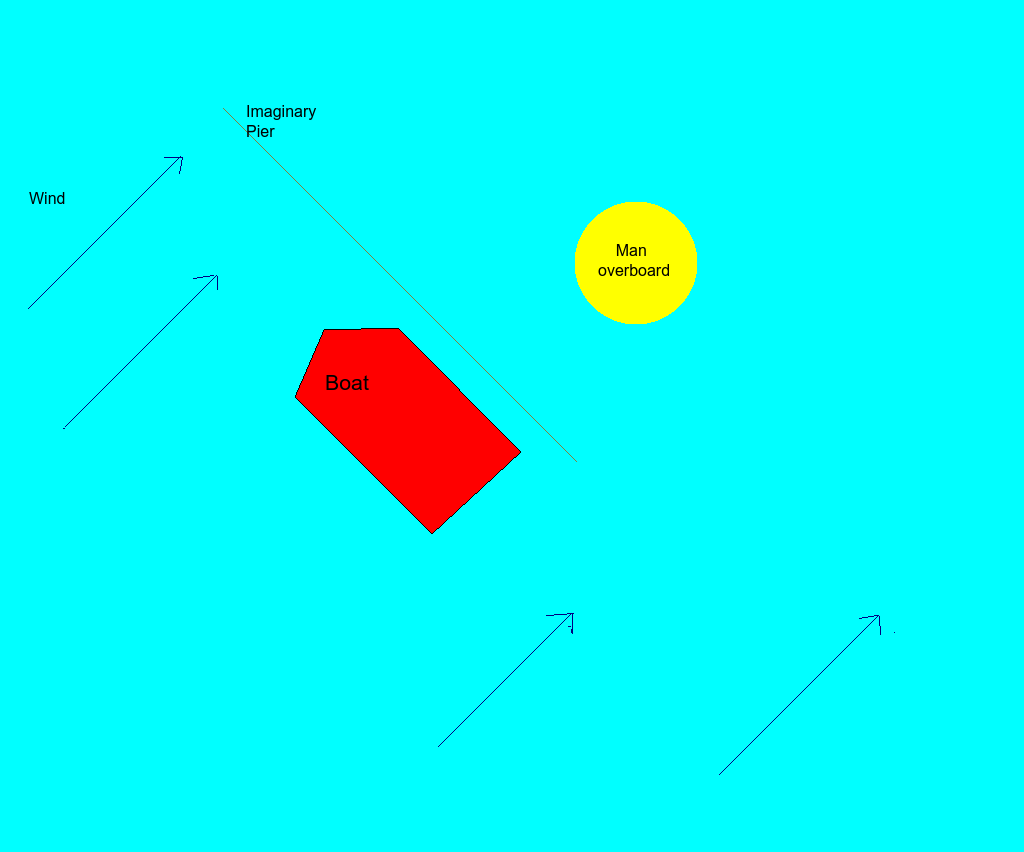
In this rescue, the wind direction plays a role. The idea is to imagine a pier perpendicular to the wind direction. Then finally do the starboard landing on the man. While making sure the propellers are at a distance from the person. The end situation needs to look something like the diagram below.
Here is a video demonstration of it (courtesy of luna sailing, Zurich)
Positioning and Navigating with a Compass and Nautical Charts
After being discovered by the Chinese, compass quickly became a prominent nautical navigation tool since the ancient times. It revolutionized how humans could navigate on the high seas where there was nothing in sight. Using compass and other primitive measurement techniques empires started to build their own nautical charts. They quickly became a source of power during the age of sail. I wish to read a book or two on the details of how cartography evolved through the ancient and medieval times. Map making is a topic close to my heart and a part of my doctoral study was on visual map making etc.
I must mention that use of compass on a modern boat is of equal importance as it gives you a heading direction. A GPS also can give a heading however the heading from it is less accurate than a compass. A modern sailboat (and motorboat) typically has a accurate magnetic compass on boat.
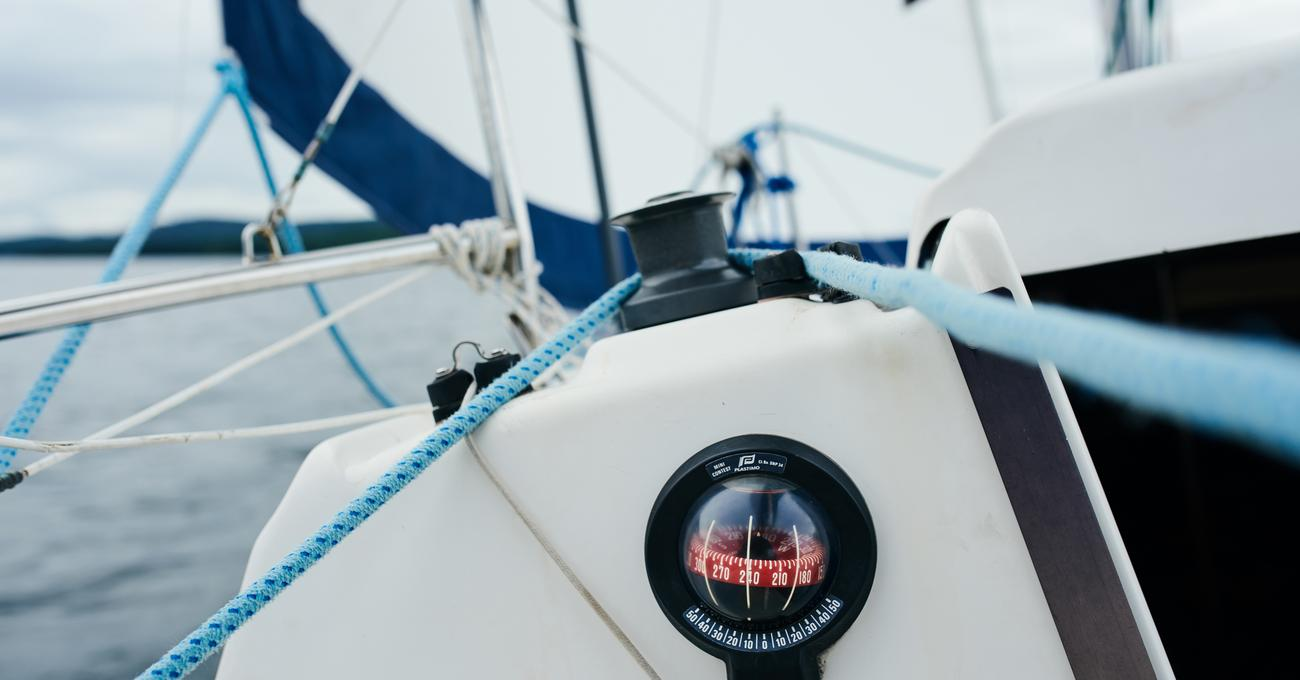
In a Swiss motorboat and sailboat test it is expected to know how to use a nautical chart and a compass to navigate. In practice, we do most of the navigation with GPS, however it is often times quite important to be able to navigate with a GPS. Some areas have poor GPS reception of you could have a drained battery and GPS failures.
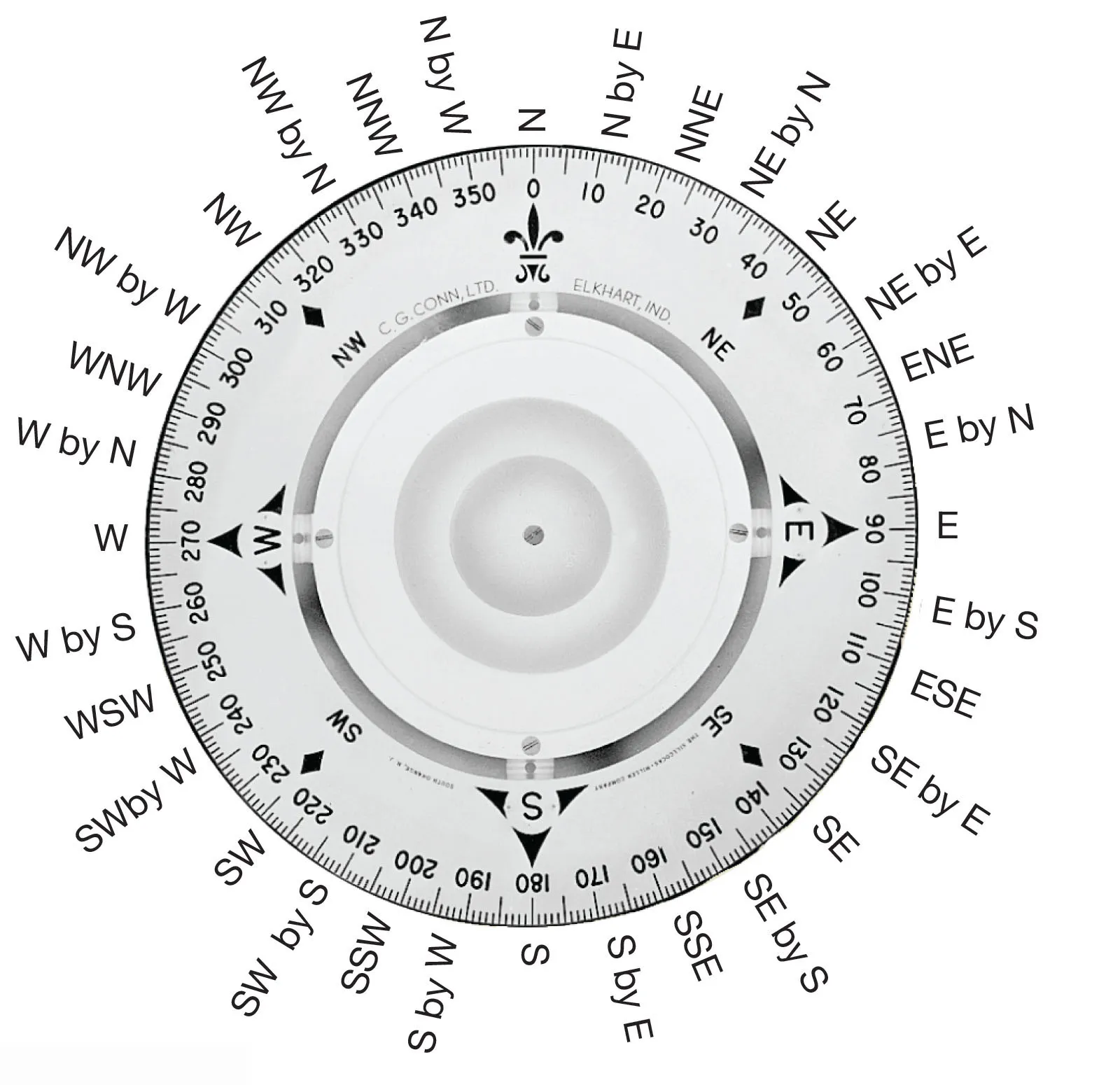
The dials on a compass looks something like below. Zero degrees is the north. 90 degrees is the east, 180 degrees is the south, 270 is the west.
There are these two tasks that an examiner expects you to know:
1. Can you mark your current position on the nautical accurately (within 5m of error) using a nautical chart and a compass?
2. Given a destination, can you figure out which heading should one steer the boat?
Determining Current Position
For this task, you will need a seekarte (Nautical chart), handheld compass and a course plotter. The idea is that you are in the middle of the lake somewhere. You can spot some identifiable objects (eg. church towers, piers etc) which are marked on the nautical chart. Then using your handheld compass find the compass angle to the known object. Then you can draw a straight line that this angle from the known landmark on the chart. You need 3 such objects (triangulation) ideally with sufficient parallax to known your position to a high accuracy. Note that a ship compass is not useful for this tasks.
The compasses give the direction of magnetic north pole and not the true north. The difference between the two north poles is called the magnetic declination. For the lake of Zurich, this is about 3 degrees. The maps are made in reference to the true north. In practice, the magnetic declination is ignored.

However in certain locations in the American continent the magnetic deviation can be upto 40 degrees. In the future, I will write a separate blog post for compass navigation while compensating for magnetic declination. This is an important topic for the sea license you might do in the future. There are several YouTube videos explaining this. I recommend to watch those. This is really easy once you do it a couple of times.
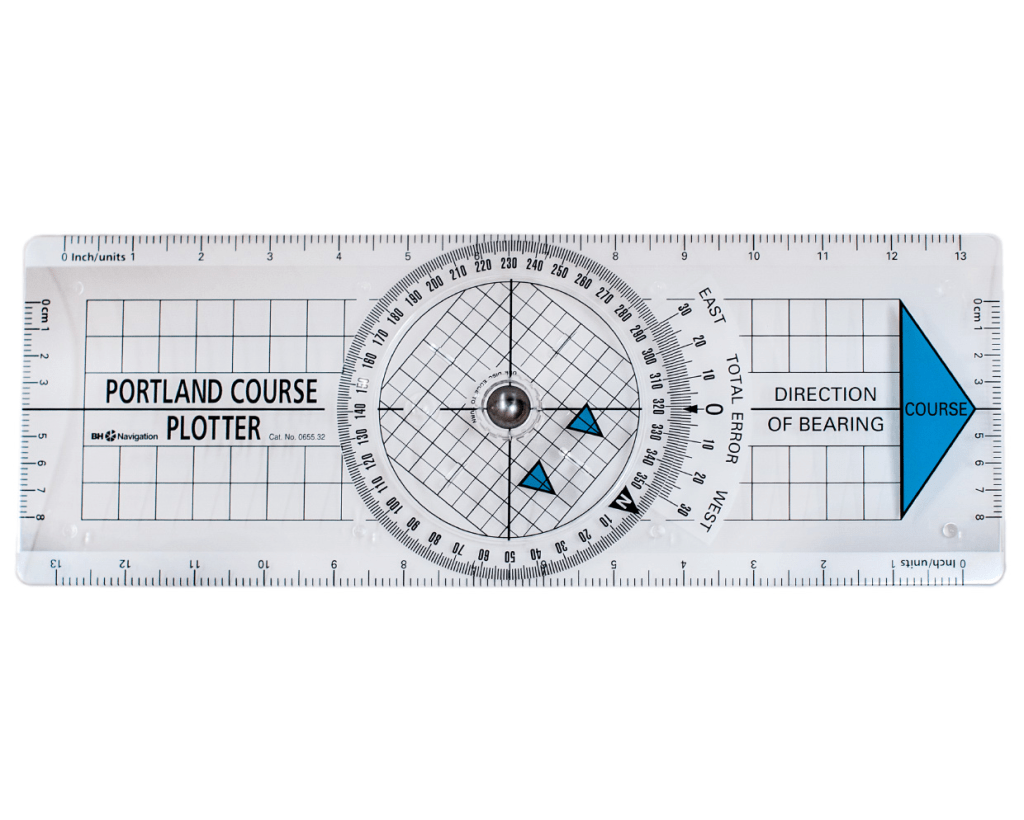
A course plotter. This has a rotating 360 dial on it and a grid. It is used draw lines on a chart for triangulation. Also it is used to know the steering angle to reach a destination.
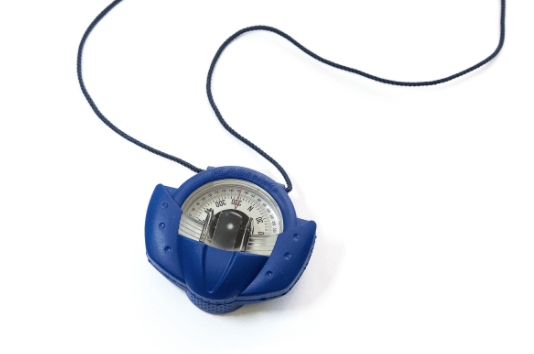
A handheld magnetic compass. It is used to know the magnetic heading angle to a object. Magnetic compass are also often times embedded in a marine binocular. See this.
Determining a Direction to the Destination
Once you know your current position, you can draw a line between your current position and your destination. Then use the course plotter, align it’s grid to the map grid. The angle pointed is the direction you want to steer to get to your destination.
Knots
Finally you are expected to know how to tie the following seeman knots. Knots are quite important to tie-up your boat to a pier. Different knots serve different purposes. The examiner will give you a rope and ask you to tie the specified knot. The examiner will likely only know the name of the knot in German. So it might be worth while knowing the names in German as well as in English. Also it might be useful to know which knots to tie when. I will make a separate post later to explain this.
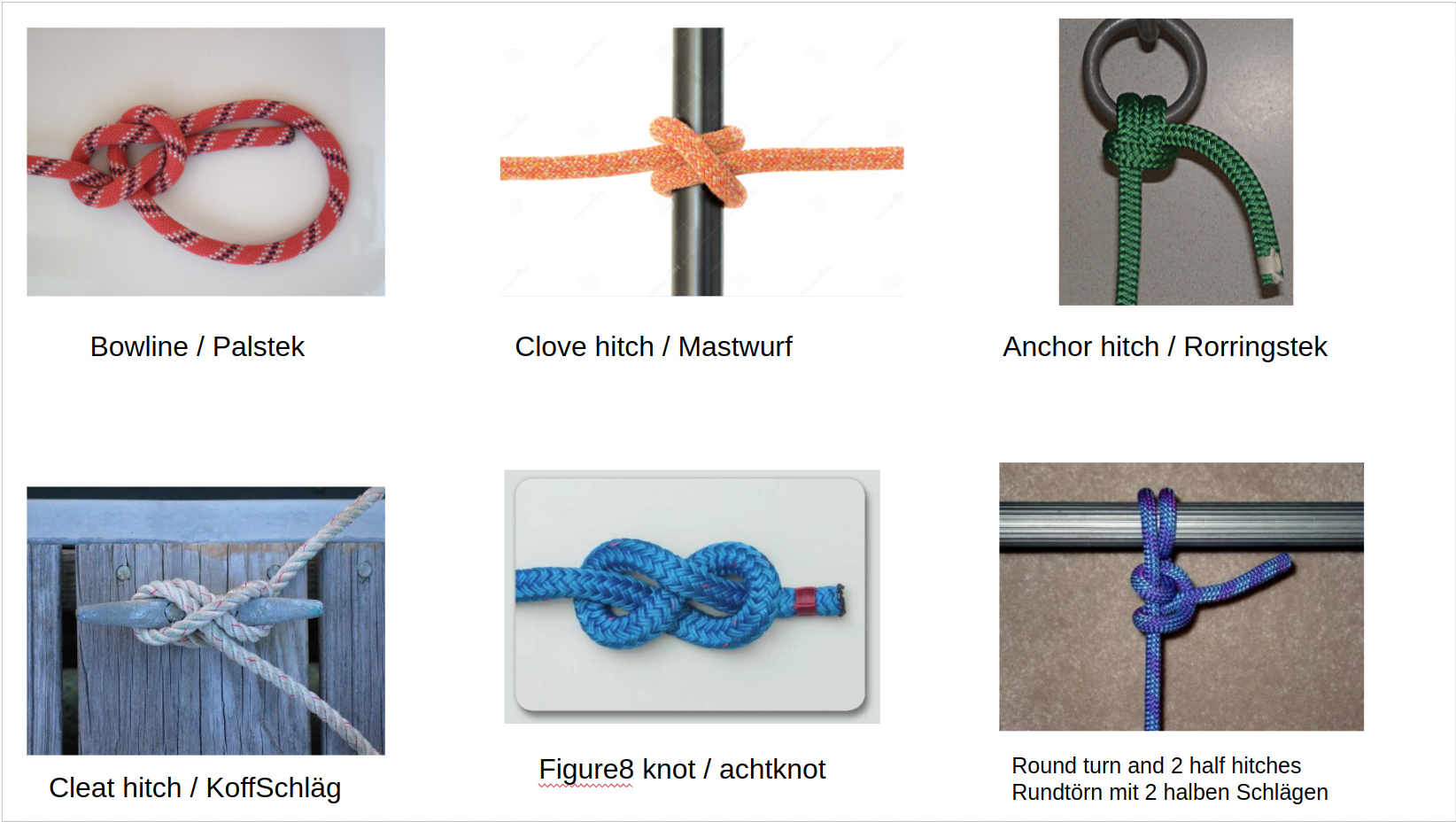
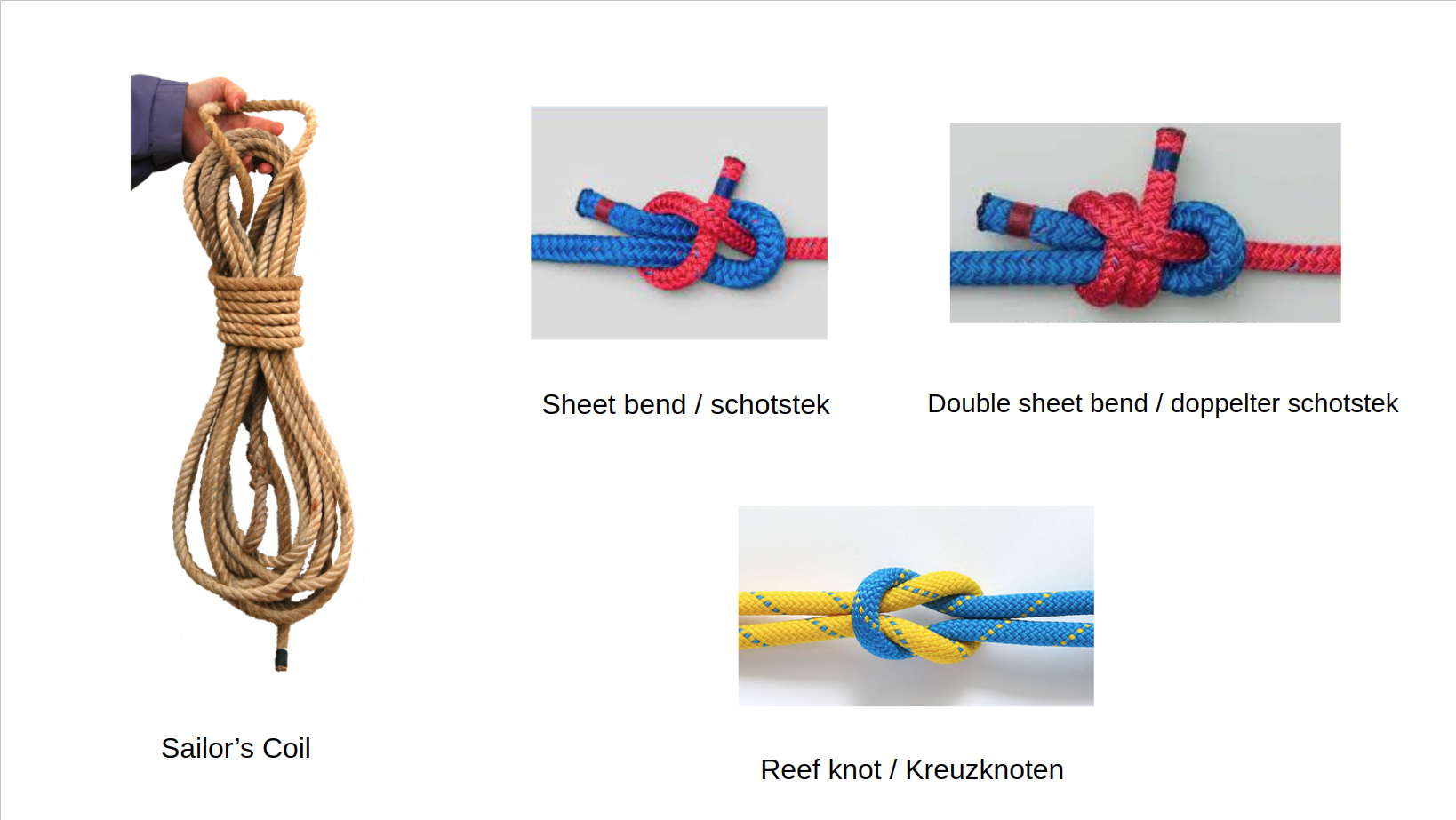
I can recommend this playlist from boatdriver.ch to learn how to tie all these knots.

 Manohar Kuse's Cyber